EN
EN
 CZ
CZ
 DE
DE
 PL
PL
 ES
ES
 FR
FR
 IT
IT
 HU
HU
 SK
SK
 UA
UA
 EL
EL
Phantom Transport: a security problem that doesn’t start on the road, but already at your company
European logistics has been undergoing a major transformation in recent years. Transport digitalisation, online freight exchanges and automated transport planning have significantly accelerated supply chain operations and enabled much more efficient use of transport capacity. Alongside these undeniable benefits, however, this development has also brought a new type of risk – phantom transport.
Whereas in the past most cases of “cargo crime” were associated with the physical theft of goods during transport or forced entry into a warehouse, today’s fraudulent mechanisms work differently. Organised groups are increasingly exploiting the digital logistics environment, the identities of transport companies and weak points in transport management processes.
At first glance, the principle behind these frauds may seem surprisingly simple. The fraudster poses as a legitimate carrier, takes over the goods and then disappears. In practice, however, this is a highly sophisticated form of organised crime that uses fake identities of transport companies, forged documents, abuse of digital freight platforms or last-minute carrier changes. According to European logistics associations and insurers, the number of these cases has risen significantly in recent years.
The key point is that today the problem often does not start on the road, but already in the logistics premises during the clearance and loading process itself. In most cases, there is no physical breach of security. The driver arrives on time, knows the job number and has documentation that appears trustworthy at first sight. If the logistics operation relies only on visual checks, phone confirmations or separate record systems, it creates room for a situation where the goods are released to the wrong vehicle, often without any visible breach of security. And this is where the role of modern systems for managing arrivals and loading begins to change.
Classic security is often no longer enough today
“Phantom transport often does not arise because of a lack of technology, but because of a lack of a unified process.”
Logistics centres have long been built primarily with an emphasis on physical security. Camera systems, fencing, gatehouses or access control were meant to prevent unauthorised movement of people and vehicles in the premises. Phantom transport, however, shows that the biggest weakness of today’s logistics does not lie on the perimeter of the site, but inside the loading process itself.
The most risky situations are not those where someone tries to force their way into a warehouse. Much more dangerous is the moment when a fraudulent vehicle passes through the standard clearance process and gains access to the cargo on the basis of a fake or stolen identity.
In many operations there are still so-called “blind spots”, i.e. processes where there is no immediate real-time validation of data. Carrier information is often scattered across emails, the ERP system, telephone communication and paper documentation. The warehouse operator at the loading dock often has no easy way to verify whether the vehicle standing at the dock really corresponds to the ordered transport. This is exactly the gap that organised groups systematically exploit today.
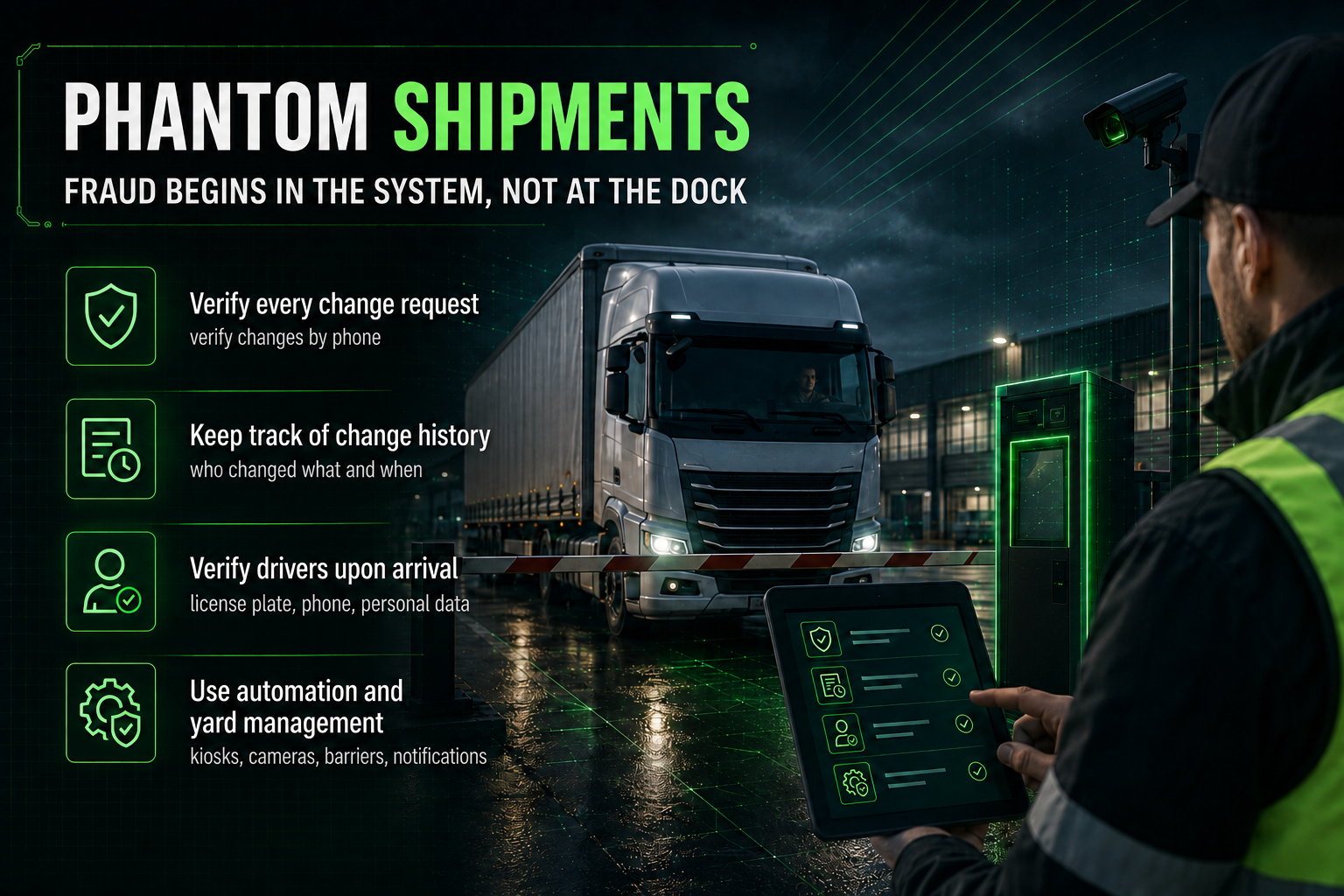
The absence of a central register is in practice one of the biggest problems when dealing with freight fraud. If carrier changes happen by phone, by email or outside the central system, it is very difficult to trace accountability afterwards. Time Slot Control, by contrast, unifies communication with carriers, arrival planning, vehicle records and approval processes into a single digitally managed workflow. Any change in the transport is immediately visible, traceable and auditable.
Another important security element is confirming the correct vehicle before loading. In logistics practice, the problem often does not arise because someone has entered the premises unnoticed, but because the goods are loaded into the wrong truck. Modern yard management therefore increasingly links slot planning with vehicle identity checks, automated gate access and digital loading confirmation. This significantly reduces the scope for human error, improvised changes or targeted fraudulent behaviour.
Time Slot Control is not just a tool for dock planning
“Modern Time Slot Management is no longer just about efficiency. It is becoming a security layer of logistics.”
Systems such as Time Slot Control were originally seen primarily as a tool for organising transport, eliminating truck waiting times and better using loading capacity. The current development of logistics risks, however, shows that their importance is much broader. It is now clear that efficiency and security can no longer be separated in logistics. The same technologies that help optimise dock utilisation, reduce waiting times or increase the throughput of logistics centres also create an important security layer protecting the supply chain from unauthorised transport.
The trend towards transport digitalisation will continue. With the growing use of freight marketplace platforms, automated transport planning and shared transport capacity, a rise in attempts to abuse these systems can also be expected. That is why it will remain increasingly important to verify the identity of drivers and vehicles even before loading or unloading begins.
One of the key elements is automatic licence plate recognition at the site entrance. The system compares the vehicle that actually arrives with the data stated in the time slot reservation and verifies the match between the order, the carrier and the physically present vehicle.
Another level of security is the self-service kiosk equipped with an identity document reader (ID card, passport). Upon arrival, the driver verifies their identity, while the system automatically compares the reservation data in Time Slot Control with the data read from the document. In the event of a mismatch or suspicious deviations, it marks the situation as risky and requests a check by an authorised employee.
If there is a discrepancy in the data, for example between the driver’s identity, the vehicle’s licence plate and the reservation, the risk situation can be detected even before handling begins. The importance of such checks is increasing further at a time when fraud groups are more and more frequently using sophisticated digital tools. The mere existence of an order, a CMR document or a correctly filled-in reservation is no longer necessarily a sufficient guarantee of transport credibility.
Current practice clearly shows that the future of logistics security will not depend only on the physical protection of premises, but above all on the ability to verify identity digitally, control access to loading and transparently record the entire logistics process.
The most critical point of the entire process is the loading dock
“The biggest risk is often not theft of goods during transport, but their release to the wrong carrier.”
The decisive moment of phantom transport does not happen during the drive, but at the moment when the warehouse releases the goods to the wrong vehicle. That is precisely why modern logistics operations are placing ever greater emphasis on identity confirmation directly during loading. It is not enough to simply record a vehicle’s arrival at the premises. What matters is being certain that the goods are actually being loaded onto the correct truck corresponding to the approved transport.
Time Slot Control creates a unified digital process that links slot reservation, vehicle arrival, its verification and the loading itself. Every step is recorded and traceable backwards. This significantly limits the scope for improvised changes, uncontrolled communication or human error. At the same time, it creates an audit trail that allows the entire logistics operation to be traced back precisely.
Records and audits are no longer just administration
One of the biggest problems in dealing with phantom transport is tracing accountability. If carrier changes take place by phone or outside the central system, it is very difficult to determine who approved the transport, when the change occurred or why the goods were released to a different vehicle. That is why audit records are now becoming an important part of logistics operation security.
Modern Time Slot Control makes it possible to create a single history of the entire transport, from slot reservation through vehicle arrival to loading confirmation. The process can also include photo documentation of the vehicle, a record of arrival time or automatic alerts about non-standard transport behaviour. Such data is important not only for internal incident investigations, but also when communicating with insurers or law enforcement authorities.
Logistics security will increasingly be based on identity verification
“A transport organisation tool is becoming an active part of supply chain protection.”
Phantom transport shows that logistics security is entering a new phase. Organised groups today attack physical infrastructure less and less, and increasingly exploit process and information weaknesses in supply chains. The future of protecting logistics operations will therefore not rest only on physical security or camera systems, but above all on the ability to verify the identity of vehicles, drivers and transport in real time.
It is precisely in this respect that the importance of systems like Time Slot Control is changing fundamentally. From an originally operational tool for transport organisation, it is gradually becoming an important part of the security infrastructure of modern logistics. And perhaps that is the biggest change phantom transport is bringing to the European supply chain: security no longer begins only during transport. It begins at the moment when you know that the carrier who created the transport reservation is the right one, and has therefore set the entire safe loading process in motion.