EN
EN
 CZ
CZ
 DE
DE
 PL
PL
 ES
ES
 FR
FR
 IT
IT
 HU
HU
 SK
SK
 UA
UA
 EL
EL
Less waiting at the entrance thanks to the connection between the reserve and the area

Booking a time window helps spread out arrivals throughout the day. But the queue at the entrance is not just caused by a bad plan. It is often prolonged by the fact that the gatehouse searches for the order again, describes the license plate, verifies the driver's contact and finds out where the vehicle should go. Meanwhile, the warehouse works with a different overview and the driver waits for the next instruction.
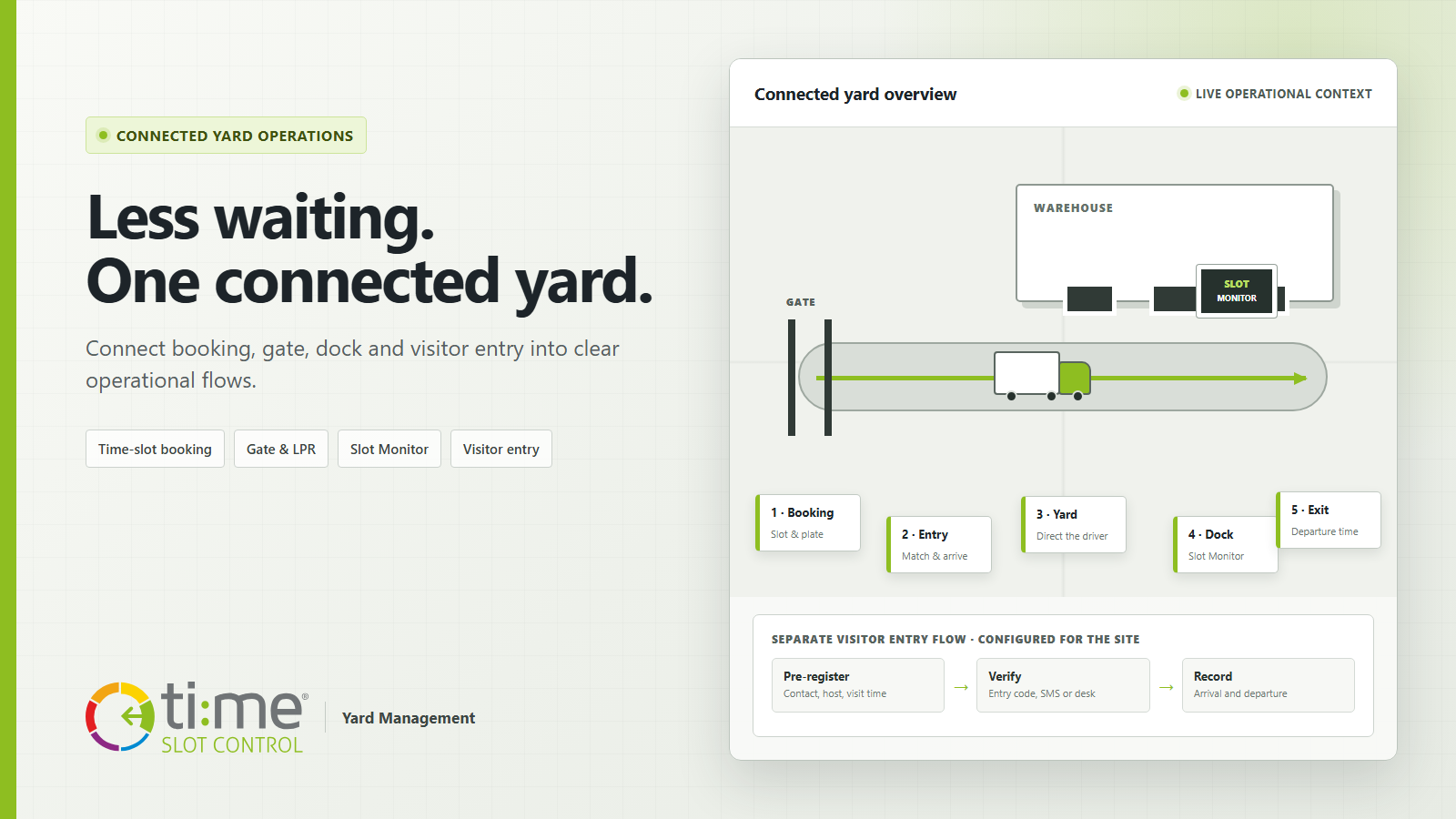
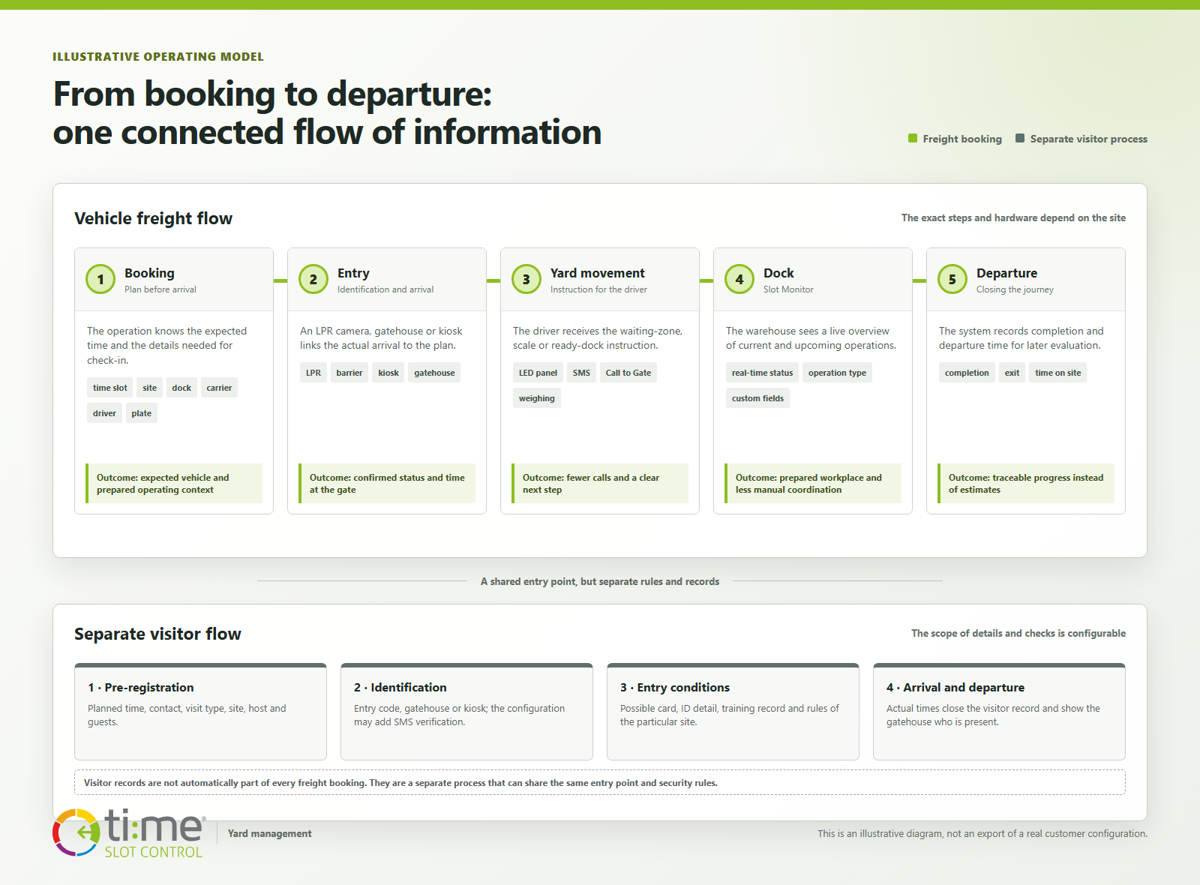
Therefore, the real shortening of waiting time begins when the reservation is not an isolated entry in the calendar. The data from it must continue to the entry process, control of movement around the premises and to the workplace that the vehicle serves. Time Slot Control for this flow connects the reservation system with yard management tools: automatic gatehouse, kiosk, LED panels, SMS/Call to Gate system and the Slot Monitor application.
Reservations will prepare the operation before arrival
A well-prepared booking gives the operation a common starting point. It includes the scheduled time window, branch and service point, type of operation, and depending on the settings, also the carrier, driver, vehicle, license plate, contact details, custom fields or attachments.
It's not about requesting as much data as possible. The point is to have exactly the information that a particular area needs for quick identification and decision-making before arrival. For example, if the license plate is already known in the reservation, the staff at the gate does not have to rewrite it again. When the workplace is predetermined, the driver's navigation and ramp preparation can follow the same plan.
At the entrance, the plan meets reality
Arrival is the moment when it is necessary to combine the planned reservation with a specific vehicle. Depending on the equipment of the area, the license plate plate can be read by an LPR camera and compared with the reservation. On confirmed arrival, the automatic barrier can continue according to the set rules and the system will record the time at the gate.
But automation is not the only possible way. The gatehouse can work with an overview of reservations and record arrival manually. A self-service kiosk, on the other hand, helps to check in drivers with a reservation and solve a scenario without prior reservation. The specific combination depends on safety rules, traffic intensity and available hardware.
A common result is important: after identification, a second, separate list is not created. The actual status and time stamp are added to the reservation, which other roles in the operation can work with.
The driver receives another instruction, the warehouse sees the same plan
After entering, the vehicle does not have to go to the ramp immediately. It can wait on the parking area, continue to the scales or be assigned another workplace. Here, the reservation data changes to the control of movement around the area.
The LED panel can display the assigned ramp or navigation instruction to the driver. The SMS/Call to Gate system can prompt the driver when the workplace is ready. The information thus reaches the driver without circling the parking lot and repeated phone calls between the gatehouse, the dispatching center and the warehouse.
At the same time, traffic does not have to pretend that each vehicle is driving in an ideal scenario. The schedule may change and the arrival may be unplanned. The advantage of a connected flow is that the change is reflected in a single operational context instead of several manually maintained tables.
Slot Monitor transfers the reservation directly to the ramp
Slot Monitor is a dedicated desktop application for workplaces and ramps. It displays current and planned operations synchronized with Time Slot Control in real time. This way, the warehouse worker does not have to wait for a phone call or refresh the exported list.
The display can be adapted to a specific workplace. Slot Monitor supports multiple layouts from a summary of several ramps to the detail of a single ramp, color differentiation of the type of operation, and configurable custom fields, language, and device profile. Therefore, the very data that the warehouse needs to prepare the operator can be seen on the screen — without publicly displaying information that it does not need to work.
The biggest benefit is not the display itself. It is continuity: the reservation determines the expected work, the arrival confirms that the vehicle is on site, and the Slot Monitor shows the current status where the loading or unloading is actually taking place.
Visitor records deal with the entry of people as a separate process
Not only trucks enter the area. Service technicians, suppliers, escorted drivers or other visitors also come. Their entry has a different purpose and often different rules than transport reservations. Therefore, it is advisable to keep visits in separate records, even if they use the same gatehouse or kiosk at the entrance.
In Time Slot Control, you can prepare the planned time of the visit, contact details, vehicle registration number, type of visit, branch, visited person and guest list according to the configuration. The process can also include an entry card, training data, identification data, entry code, confirmation at the kiosk or phone verification via SMS. The system then records the actual arrival and departure.
The scope of data and controls must always correspond to the rules of the specific operation. Not every area needs all the steps and the visitor record is not automatically linked to every vehicle reservation. The main benefit is that the gatehouse knows in advance who to expect, who the visitor is going to and which conditions must be met at the entrance.
Where the wait really gets shorter
A linked process does not remove the physical capacity of the gate or ramp. However, it does eliminate the delays that arise between each step:
- Less search at the entrance: the scheduled time, license plate, and operating context are ready before arrival.
- Less manual rewriting: An actual arrival will complement an existing booking instead of creating a parallel record.
- Fewer phone calls: LED panel or SMS/Call to Gate gives the driver another instruction.
- Faster ramp preparation: Slot Monitor shows the current and following operations in stock.
- Clearer people entry: Pre-registration of visits separates expected visitors from unknown arrivals.
- Better traceability: Arrival, service start, completion and departure times form the basis for evaluating the actual progress.
One solution does not mean one mandatory report
An area with one ramp can start with reservations and a simple overview at the workplace. In traffic with higher intensity, an LPR camera, an automatic barrier, a waiting zone, LED navigation, weighing and multiple Slot Monitors can make sense. Visitor records can be deployed separately according to the requirements of the gatehouse and security.
The modular approach makes it possible to combine software and hardware where they shorten a specific delay. The key is to describe in advance who decides on entry, how the vehicle is identified, where the driver gets the instruction from, what he needs to see the warehouse and how the departure is recorded. Only then does it make sense to choose equipment and automation steps.
What to watch after deployment
Success is not measured by the number of displays installed. Practical indicators are the time from arrival to entrance, waiting from gate to start operation, total vehicle time on site, the proportion of arrivals without prepared data, and the number of manual interventions by the gatehouse. Time stamps in one process help to distinguish a planning problem from a problem at the gate, on the parking area or on the ramp.
You can find more about each option on the Site Management page and in the Time Slot Control solution overview.
Do you want to shorten the waiting time on your premises?
Let's start with the map of the actual passage: from the creation of the reservation to the gatehouse and waiting area to the ramp and departure. Together, we determine which data should be prepared in advance, where delays arise and which modules or devices have a real benefit for your operation.
Describe your operation to us and we will suggest a suitable combination of bookings, entry process, Slot Monitor and visitor management.