 EN
EN
 CZ
CZ
 DE
DE
 PL
PL
 ES
ES
 FR
FR
 IT
IT
 HU
HU
 SK
SK
 UA
UA
 EL
EL
How the Vaillant Group Streamlined Logistics at Its Manufacturing Plants
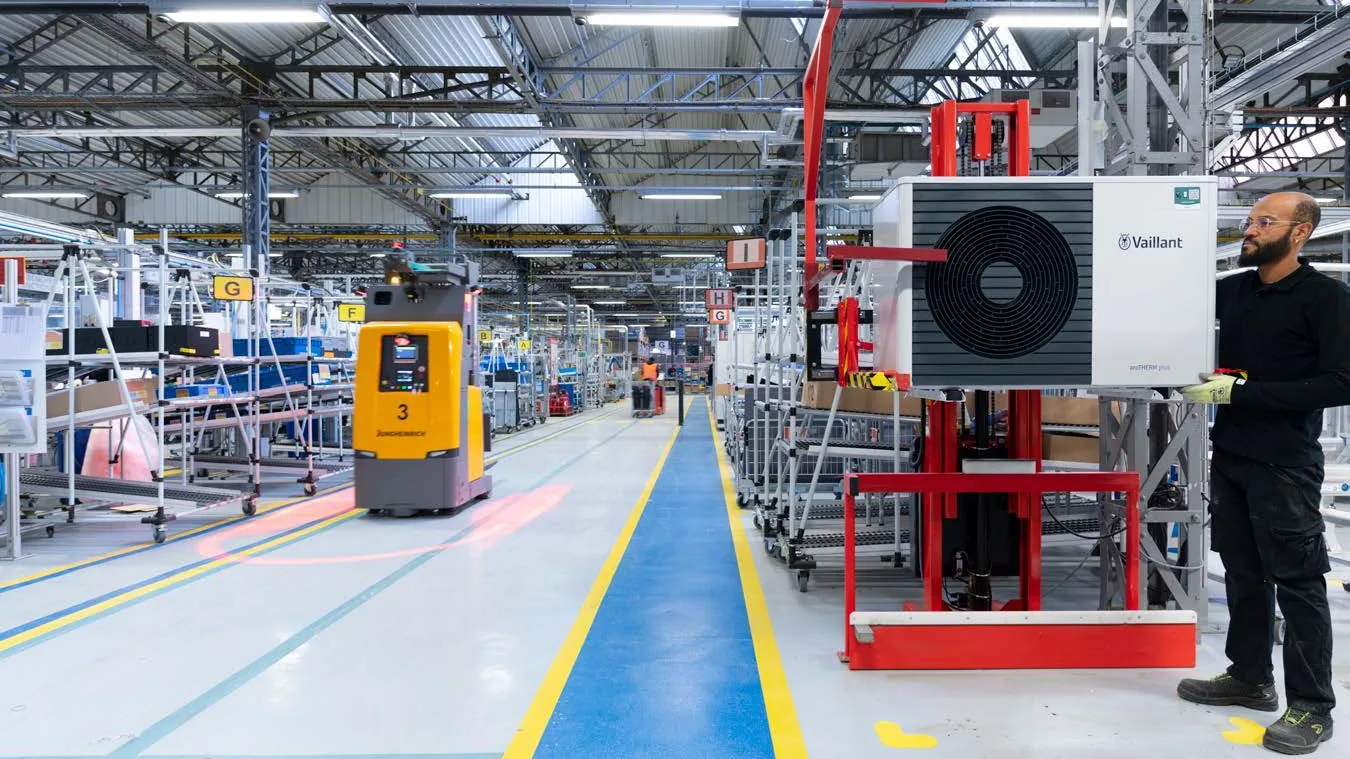
In 1894, Johann Vaillant obtained a patent for a bathroom stove with a closed gas system. Today, the Vaillant brand provides reliable solutions for home heating. In 2023, a new logistics centre and a new heat pump manufacturing plant were established in Senica.
The logistics management project at the Vaillant manufacturing plant in Senica was built from the ground up. The implementation of Time Slot Control brought transparency, flexibility, and data-driven planning to our logistics.
David Baláž — Digital Plant Coordinator, Vaillant Group

pallets handled per day, before and after go-live
logistics operations performance
to high-quality data for optimising docks and time slots
Why did you decide to look into selecting a system for planning loading and unloading?
The primary reason was the need to obtain high-quality data and transparent information for managing logistics performance. We wanted a clear and measurable overview of how our logistics operations are utilised, what the actual capacity needs of personnel and equipment are, and how logistics responds to changes in production. The goal of the project was not direct cost savings, but rather to increase efficiency, organisation and the ability to objectively evaluate operational processes.
Furthermore, experience from other plants, specifically the warehouse in Skalica, gave us a clear idea of how a modern time slot management system should work. Thanks to this, we entered the project with very specific requirements. Today, the system also serves as a transparent tool for capacity management: it clearly shows whether logistics are efficient, whether there is a problem in the organisation of operations, or whether there is a genuine need to increase staffing levels.
How did you go about searching for a time slot management application?
It wasn't a formal tender process without a prior concept. We knew exactly what solution we were looking for. Our first contact with the Time Slot Control system took place at the end of 2022 at the SLOVLOG conference, where we met representatives of Lotraco and began discussing specific options for implementing the project.
Several presentations and internal discussions followed throughout 2023, culminating in a presentation of the concept to the parent company. Another important milestone was getting to know Time Slot Control at our external warehouse, which Fiege operates for Vaillant in Austria. System testing began in September 2023 and the contract was signed in December 2023.
How did the system implementation go? Did you encounter any issues, and did everything proceed on schedule?
The implementation went very smoothly, mainly because we knew exactly what we wanted from the start. The project began with a trial run with a single supplier, during which we tested the system and at the same time established an internal framework of rules for its consistent use.
The biggest challenge was not the technical side, but changing users' mindsets, both within logistics and at the gatehouse. The initial training and the subsequent “evangelisation” of the system within the company played a key role. Support from Time Slot Control was flawless throughout. Another major advantage was the system's high intuitiveness and flexibility, which allowed us to fully adapt it to our internal conditions without complex interventions by the supplier.
What changes did you notice after implementation? Did it have any benefits or advantages?
A fundamental change was the clarity and transparency of the entire operation. After about six months we had high-quality data at our disposal, which we used to optimise logistics processes and dock utilisation, monitor the utilisation of individual time slots and gradually onboard additional suppliers.
The project was largely implemented from scratch, which allowed us to obtain very precise input data: how many vehicles arrive, what their delays are and what the real impact is on logistics and production. Based on this information, we were able to better align logistics with production needs.
Have you quantified the savings generated by the TSC application? Or do you have any other specific data on how efficiency has improved thanks to TSC?
The primary goal of the project was not savings, but transparency and efficiency. Nevertheless, we can now quantify the increase in operational performance. While we were able to handle approximately 500 pallets per day before the system was introduced, after implementing Time Slot Control the figure is roughly 700 pallets per day. This data clearly demonstrates the system's contribution to the overall efficiency of our logistics operations.
How did business partners, customers and carriers adapt to the system?
The adaptation was surprisingly quick. Carriers very soon realised that the system benefits them too, especially in terms of transparency. In the event of disputes or additional costs, clear data is now available that unequivocally shows whether a claim is justified.
At the beginning, we faced challenges mainly on our side, such as setting up a sufficient number of time slots. It also turned out that unloading itself accounts for only about a third of the time, while the rest is spent on internal record-keeping and putting the material away. We therefore had to set the slot lengths correctly and align the expectations of all parties.
Why TSC from Lotraco?
We compared the solutions available on the European market. The main criteria included SAP integration, the comprehensiveness of the solution, flexibility, clarity, local support and total costs. Based on an evaluation of these criteria, Time Slot Control emerged as the most suitable and adaptable solution for our needs. The system's flexibility and high-quality local support were the deciding factors.
How satisfied are you with the application, the user interface and technical support?
We are very satisfied with the application. We particularly appreciate being able to fully administer and configure the system ourselves, without needing the supplier's intervention. Technical support is of a very high standard. Minor outages occurred only in connection with a sharp increase in the number of time slots, and these were quickly resolved.
What benefits of TSC would you highlight?
The key benefit is the availability of data and its usability for production and logistics planning. Thanks to Time Slot Control, we can respond in good time to changes in production schedules, optimise the number of docks and staff, and identify potential issues on the carriers' side. The system provides transparency not only to managers but also to warehouse staff, who have a complete overview of upcoming material flows in both receiving and shipping. Looking ahead, we see great potential in further integration with production and a higher degree of automation.
Would you recommend TSC to another company in your industry?
Yes, definitely. Especially to companies with complex logistics and close ties to production. In this project our primary goal wasn't savings, but significant benefits: transparency, data and the ability to manage logistics based on facts, not impressions.