EN
EN
 CZ
CZ
 DE
DE
 PL
PL
 ES
ES
 FR
FR
 IT
IT
 HU
HU
 SK
SK
 UA
UA
 EL
EL
More accurate Track & Trace and ETA for logistics teams

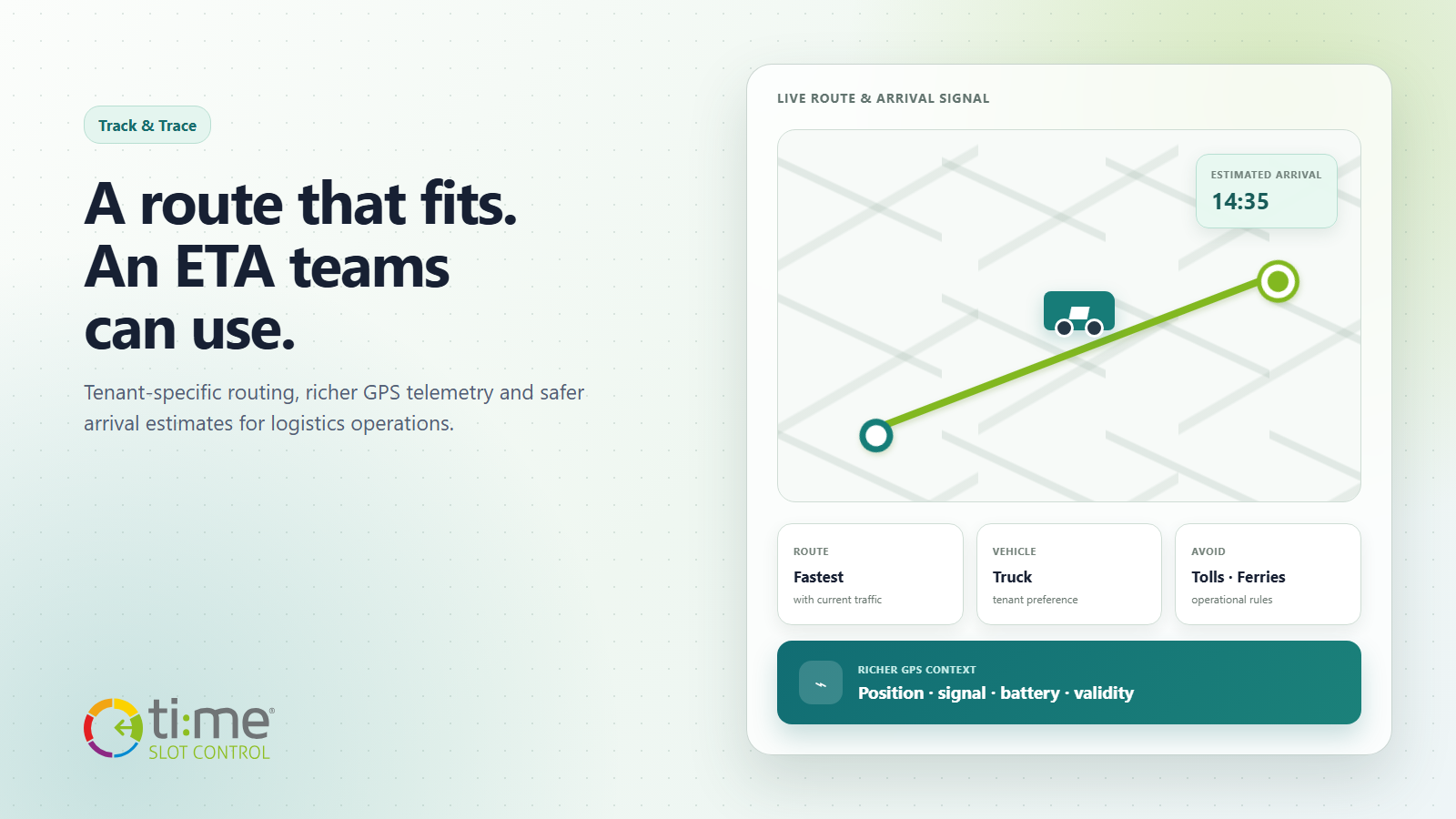
An estimated arrival time is useful only when it is based on usable coordinates and a route that reflects the real operation. The fastest route for a passenger car may not suit a truck, while a route involving toll roads, a ferry or a border crossing may not match a particular company's rules.
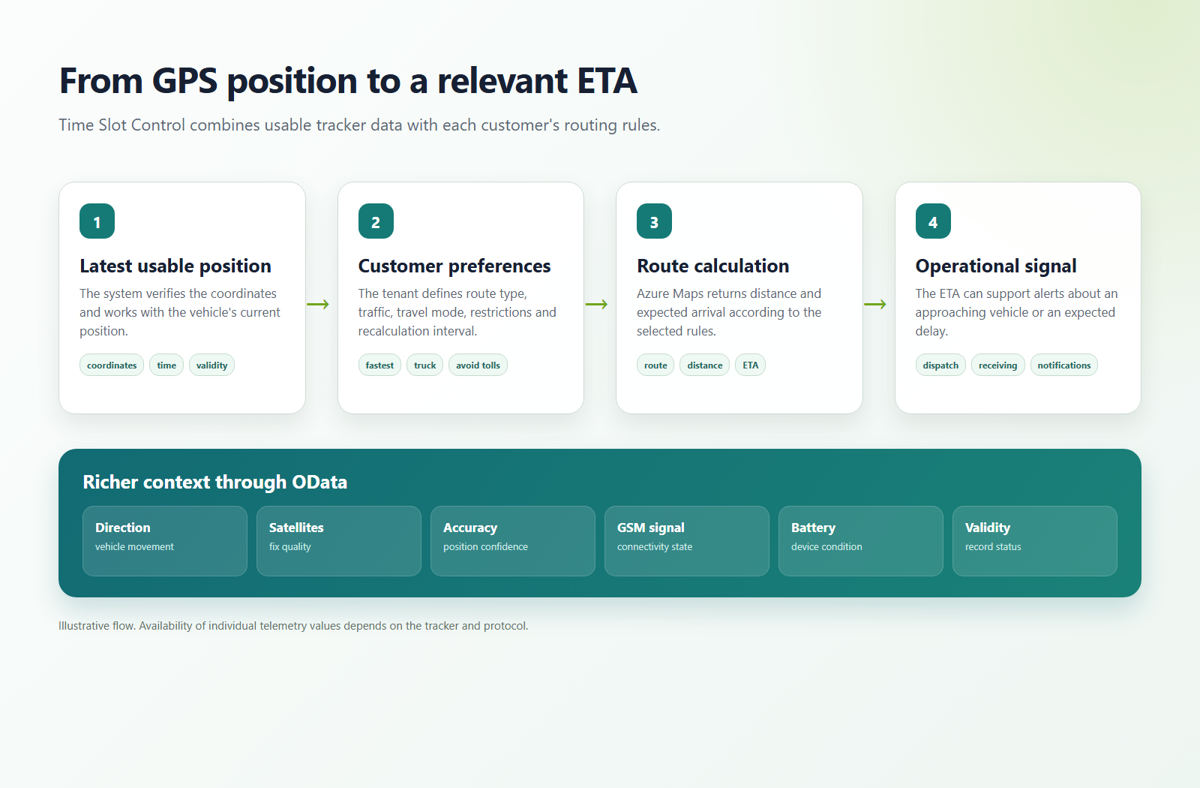
Time Slot Control therefore combines tenant-specific route preferences, a regularly updated estimated time of arrival (ETA) and richer GPS telemetry. Dispatchers and receiving teams can work with information that better reflects their own logistics scenario.
One default route does not fit every operation
Each customer environment can define how routes and ETA are calculated in the Track & Trace administration. The choices are stored separately for that customer, so different companies do not have to share one universal calculation model.
- Route type: fastest, shortest or eco.
- Current traffic: an option to include traffic conditions in the calculation.
- Travel mode: truck or passenger car.
- Route restrictions: avoid toll roads, motorways, ferries, unpaved roads, tunnels or border crossings.
- ETA calculation: it can be enabled or disabled for a specific environment.
- Recalculation frequency: configurable from 15 minutes to 12 hours.
The default values preserve the previous behaviour: the fastest route with current traffic, truck mode, no optional restrictions and recalculation after 15 minutes. Administrators can adjust the preferences without an update unexpectedly changing the result for existing customers.
ETA starts with the latest usable position
Track & Trace continuously works with the tracker's latest position and the transport destination. Before calculating the route, it checks whether the coordinates are usable. An invalid or incomplete position therefore does not result in a misleading distance calculation or interrupt processing.
When ETA calculation is enabled and the vehicle has moved far enough since the previous calculation, Time Slot Control sends the current position, destination and the customer's route preferences to Azure Maps. It stores the expected distance and arrival time from the response. The result can then support operational alerts, for example that the vehicle is approaching or is likely to arrive later than its planned time.
The recalculation interval has a minimum of 15 minutes. Both the user interface and the server enforce this limit, so an incorrectly entered lower value cannot cause excessive calls to the mapping service.
Richer GPS data for oversight and integrations
A dot on a map does not explain everything. In addition to the timestamp, coordinates and speed, the OData interface for GPS positions therefore exposes further telemetry values:
- direction and altitude,
- satellite count and position accuracy,
- device status and the record validity flag,
- GSM signal strength and battery level.
The tracker's SIM card identifier, CCID, is also available through the API. The exact set of populated values always depends on the tracker's capabilities, the protocol in use and the data the device actually sends. An integration can therefore distinguish a weak signal, a low battery or a record marked invalid by the device instead of treating every anomaly as a route problem.
What this means in daily operations
Dispatchers work with a more relevant route
If a company normally uses trucks, avoids ferries and wants to account for current traffic, it can set these choices once for its environment. The ETA then uses the same operational framework that dispatchers apply when planning.
Receiving teams get a better timing signal
An updated estimate helps teams decide whether to prepare for arrival, adjust the processing order or address a delay early. ETA does not replace the booked slot; it complements it with a current estimate based on the vehicle's actual movement.
Transport coordinators have more diagnostic context
Richer telemetry helps distinguish an operational change from a device or connectivity issue. Through OData, the data can also feed custom dashboards, integration checks or connected systems.
ETA is an estimate, not a guaranteed time
The result depends on an up-to-date GPS position, the quality of data from the tracker, the selected route preferences and the information available to the mapping service. Traffic conditions may also change after the most recent calculation. ETA should therefore be used as an ongoing operational signal together with the reservation, transport status and communication with the carrier.
Would you like to configure Track & Trace around your routes, vehicles and receiving process? Contact us. We can help you select suitable preferences, a recalculation interval and the right way to connect GPS data to your downstream systems.